
Community + network aren't the same thing
By Leyya Sattar
What 13+ Years of Community Building Has Taught Me
I was recently invited back to WACL’s Festival of Talent in Manchester to join a conversation about community building, which felt like an appropriate subject. I've spent more than a decade building communities in one form or another. At the beginning of my career, the focus was on female entrepreneurship, then on women in the creative industries, and then, through Other Box, on professionals from backgrounds that have historically been othered or excluded.
With Other Box, that grew from a community into a business spanning digital education, workplace consultancy and IRL gatherings. Now, with Studio 404, I'm thinking about community again, but deliberately through physical spaces, cultural experiences and what happens when people actually spend time together OFFLINE BY DESIGN™.
We covered a lot on the panel, but there was also plenty I didn't get the chance to say.
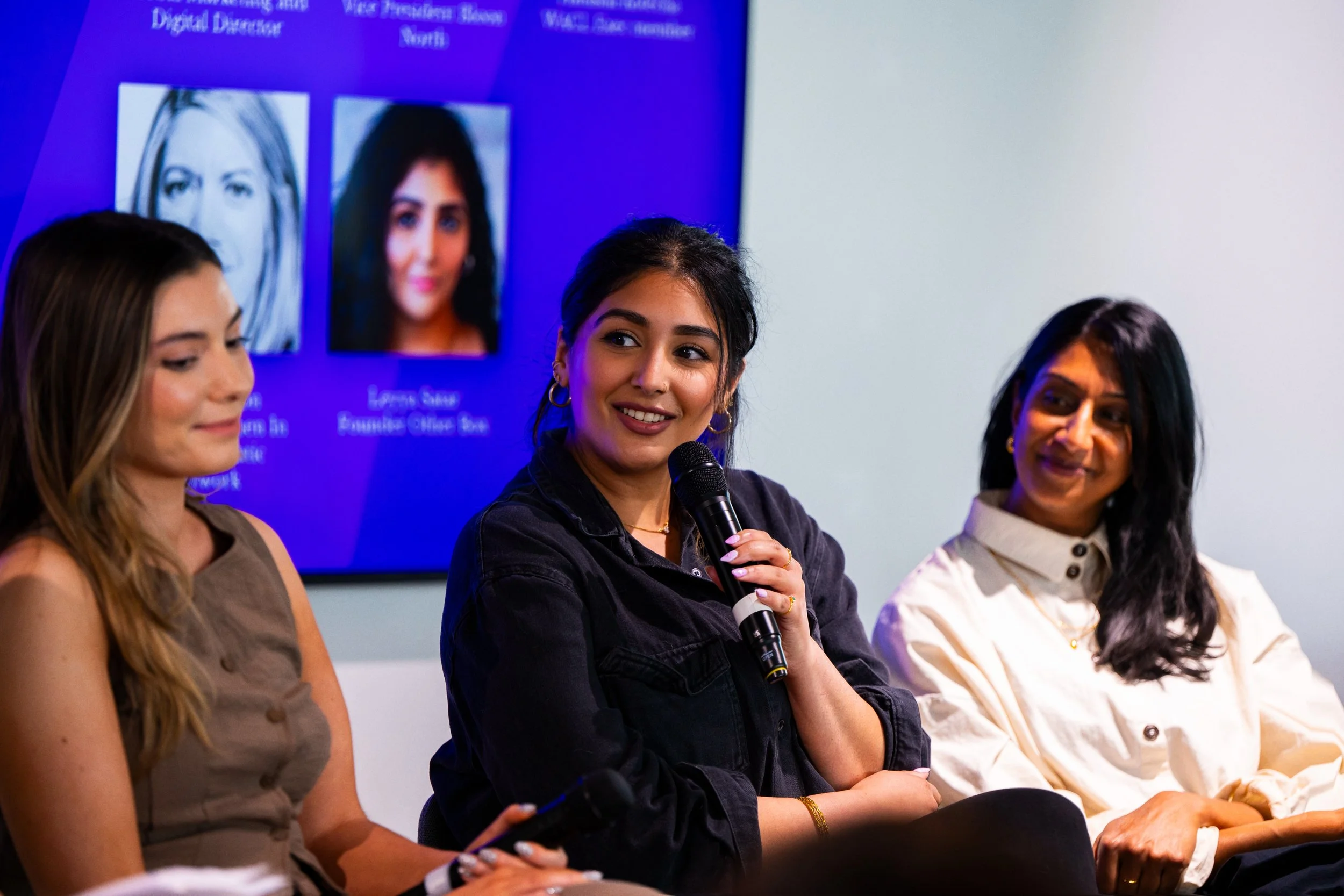
© Bronac McNeill Photography
Community and network aren't the same thing
The words “community” and “network” are often used interchangeably, but I think they're different.
A professional network is largely about connections and access. It creates pathways where information, introductions, recommendations and opportunities can move. For me, community contains connection too, but it usually asks for something deeper: belonging, participation, care and mutual investment.
For example, your network might tell you about a job, but your community might sit with you after you've lost one. And sometimes, of course, the same people do both. This distinction became particularly interesting when we discussed redundancy. When something happens that destabilises your professional identity, you often need two forms of support simultaneously.
You need people who can remind you who you are when your confidence has taken a knock.
You need people who know what you're capable of and can put your name into rooms you're not currently in.
That's why developing both is equally important.
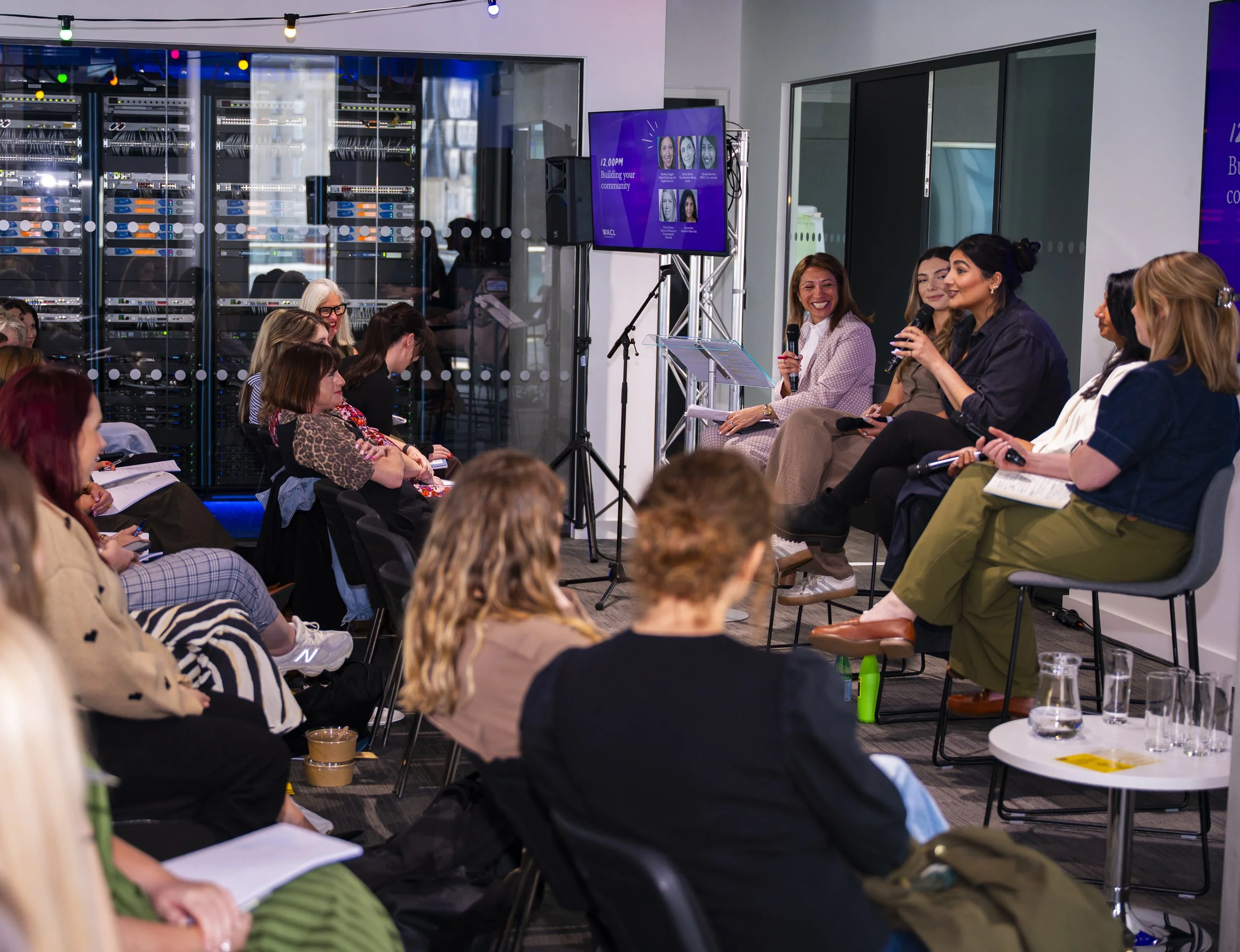
© Bronac McNeill Photography
Self-promotion isn't a dirty word
During the conversation, a number of women talked about how uncomfortable self-promotion makes them feel, and how posting on LinkedIn gave them “the ick”. I understand why. There are cultural, gendered, and structural reasons why some people have been conditioned to believe that talking about their achievements is arrogant while watching others do precisely the same thing without consequence. But there is also a practical reality! People cannot advocate for something they don't know you want. Or recommend expertise they don't know you have. And they can’t celebrate work you've spent your entire career minimising. And they sure as hell can’t connect you to an opportunity if you've never told anyone you're looking for one.
I wouldn't claim that self-promotion is some simple cure for imposter syndrome, but I do think there's a contradiction worth interrogating when we want to be recognised and resist giving people the information they need to recognise us.
To have a village, you have to be a villager
This is probably the biggest thing community building has taught me. We talk constantly about wanting a village, but a village isn't simply a group of people waiting to support you whenever you need them. You have to participate in creating it.
Sometimes that's celebrating somebody publicly when they've done brilliant work.
Sometimes it's making an introduction with absolutely nothing in it for you.
Sometimes it's answering the message from somebody five years behind you in their career.
Sometimes it's sharing the opportunity you can't take.
Sometimes it's simply turning up to events when you say you will.
Healthy communities give and take. And you then notice very quickly when someone treats a community exclusively as an audience for their own self-promotion. There's nothing wrong with wanting people to know about your work. But if every interaction begins with ‘What can I extract from these people?’, you aren't really participating in a community.
Not everything called a community is actually a community
“Community” has also become very popular term in recent years. Brands want communities. Businesses want communities. Platforms think they’re communities. But gathering a large number of people around a common interest doesn't necessarily create one.
An audience isn't automatically a community.
A mailing list isn't automatically a community.
Customers aren't automatically a community.
People standing in the same room aren't automatically a community either.
For me, the distinction is between relationship and reciprocity. Do people interact with one another rather than only with the person or organisation at the centre? Would something meaningful remain if the brand disappeared? Do people contribute to the health of the group? Is there trust? Does participation matter?
Community can absolutely coexist with commercial activity. But the moment community becomes primarily a softer word for customer acquisition, something changes and people can usually feel it.
Communities aren't automatically psychologically safe
There is another side of community building that receives less attention, which is that it can be cliquey. They can reproduce the hierarchies they claim to challenge. They can become dominated by a handful of people. They can make newcomers feel like everybody else received a handbook they somehow missed.
Calling a space inclusive doesn't mean everyone experiences it as inclusive.
As people building communities, I think we hold a degree of responsibility for creating conditions of care, respect, and psychological safety. But psychological safety also isn't something a community leader can simply declare into existence. People arrive with different histories, needs, identities, sensitivities, and thresholds.
That means there is another truth worth saying: You do not have to remain in every community you join.
Belonging should not require endlessly persuading people to respect you. If a space repeatedly makes you smaller, if your presence isn't valued, or if remaining there requires abandoning too much of yourself, leaving can be a perfectly legitimate response. Not every community has to be your community.
Difference matters. Coalition does too.
One thing I didn't get the opportunity to explore on stage was the amount of energy marginalised communities can spend arguing amongst ourselves. Some of those conversations are necessary. Language shapes reality. Different groups have different experiences. Broad categories can flatten meaningful differences and conceal inequalities within inequalities. But I also think we have to ask what happens when precision turns into immobility.
At a time when far-right movements hostile to marginalised people are capable of mobilising incredibly effectively around shared objectives, how much of our own energy do we want to devote to fighting people whose politics are fundamentally aligned with ours?
We should be capable of holding two thoughts at once: Difference deserves specificity.
And: Coalition requires occasionally finding common ground despite differences.
The question I increasingly ask myself is not simply Am I correct? But is this where my energy is most useful?
Community is something you practise
After more than 10+ years of doing this work, I've become more interested in community as a practice.
Who do you champion?
Who do you make space for?
Whose name do you mention when they're not in the room?
Who gets welcomed when they arrive alone?
Who receives your knowledge without having to earn access to you first?
Who have you connected simply because two people should know each other?
Community isn't only somewhere we go to feel that we belong. It's something we create through how we behave towards other people. Which brings me back to the simplest version of everything I said at WACL:
If you want a village, be a villager.
